Introduction
Businesses operating in data-driven environments often underestimate the real cost of poor data quality. When records appear multiple times across pipelines or inconsistencies accumulate silently, entire decision-making frameworks become unreliable. Understanding How to Handle Duplicate Data in Web Scraping Projects is no longer optional for companies that depend on structured data to guide their strategies and daily operations.
The impact of redundant or mismatched data goes far beyond minor reporting errors. It affects pricing models, market analysis, and customer engagement initiatives. Companies investing in Web Scraping API Services need clean, structured, and validated datasets that eliminate redundancies before they cause broader operational damage across business units.
When organizations fail to establish a proper deduplication process early in their data workflows, recovery becomes expensive and time-consuming. Applying Best Practices for Web Scraping Data Cleaning at the pipeline level allows teams to intercept errors before they propagate, ensuring that insights derived from extracted datasets remain accurate, actionable, and trustworthy.
The Client Story
A growing e-commerce intelligence firm approached us after facing persistent accuracy problems in their product database. Their scraping operations pulled data from hundreds of retail websites simultaneously, but without a consistent deduplication logic in place, the same product listings were appearing multiple times with conflicting attributes. They needed a structured solution to Remove Duplicate Records From Scraped Datasets efficiently and at scale.
Their internal teams had attempted manual cleanup routines, but the sheer volume of incoming records made this approach impractical. Errors were compounding weekly, causing downstream tools to generate misleading competitive reports. The client specifically required a scalable process that could manage Scraped Data for Handle Duplicates and Inconsistent Data without slowing their data refresh cycles or requiring constant human intervention.
Beyond deduplication, the client wanted a reliable system that could standardize data formats across different sources, flag suspicious entries automatically, and produce audit-ready outputs. Applying Best Ways to Clean Data After Web Scraping was central to their long-term vision of building a self-sustaining data infrastructure that could scale with their business without sacrificing integrity or consistency.
The Challenges
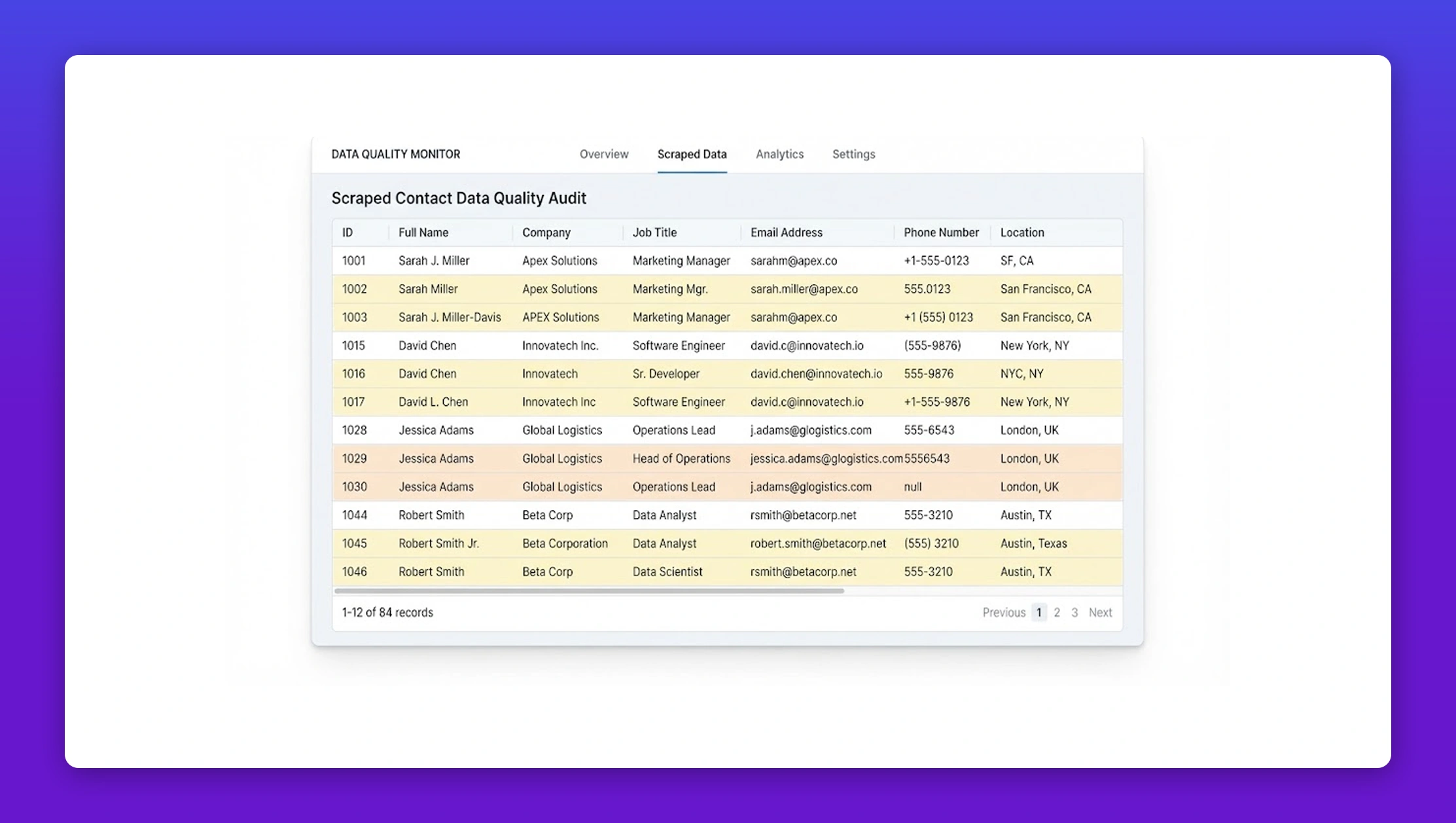
Before engaging with us, the client encountered a series of deeply embedded data quality issues that disrupted operations across multiple departments. Their pipelines were pulling thousands of records daily, but without any validation layer, errors moved through undetected until they caused visible reporting failures. Implementing proper methods to Remove Duplicate Records From Scraped Datasets had never been prioritized, and that gap was now costing them significantly.
Their analytics team struggled to build reliable dashboards because the source data contained redundant entries, mismatched field formats, and inconsistent naming conventions. Managing Scraped Data for Handle Duplicates and Inconsistent Data became a critical requirement rather than a background concern.
Key challenges included:
- Duplicate product listings inflating inventory counts and distorting pricing comparisons across competitor datasets.
- Inconsistent field formats causing failures during data merges and integration with analytics tools.
- No automated mechanism to flag repeated records or conflicting attribute values in real time.
- High manual processing overhead that delayed data refresh cycles by several hours each day.
- Absence of data lineage tracking, making it impossible to trace where specific errors originated.
These issues collectively undermined the client's credibility with internal stakeholders who relied on accurate datasets. Without intervention, the gap between collected data and usable intelligence was only going to widen as their scraping operations continued to expand into new markets and additional data sources.
The Solutions
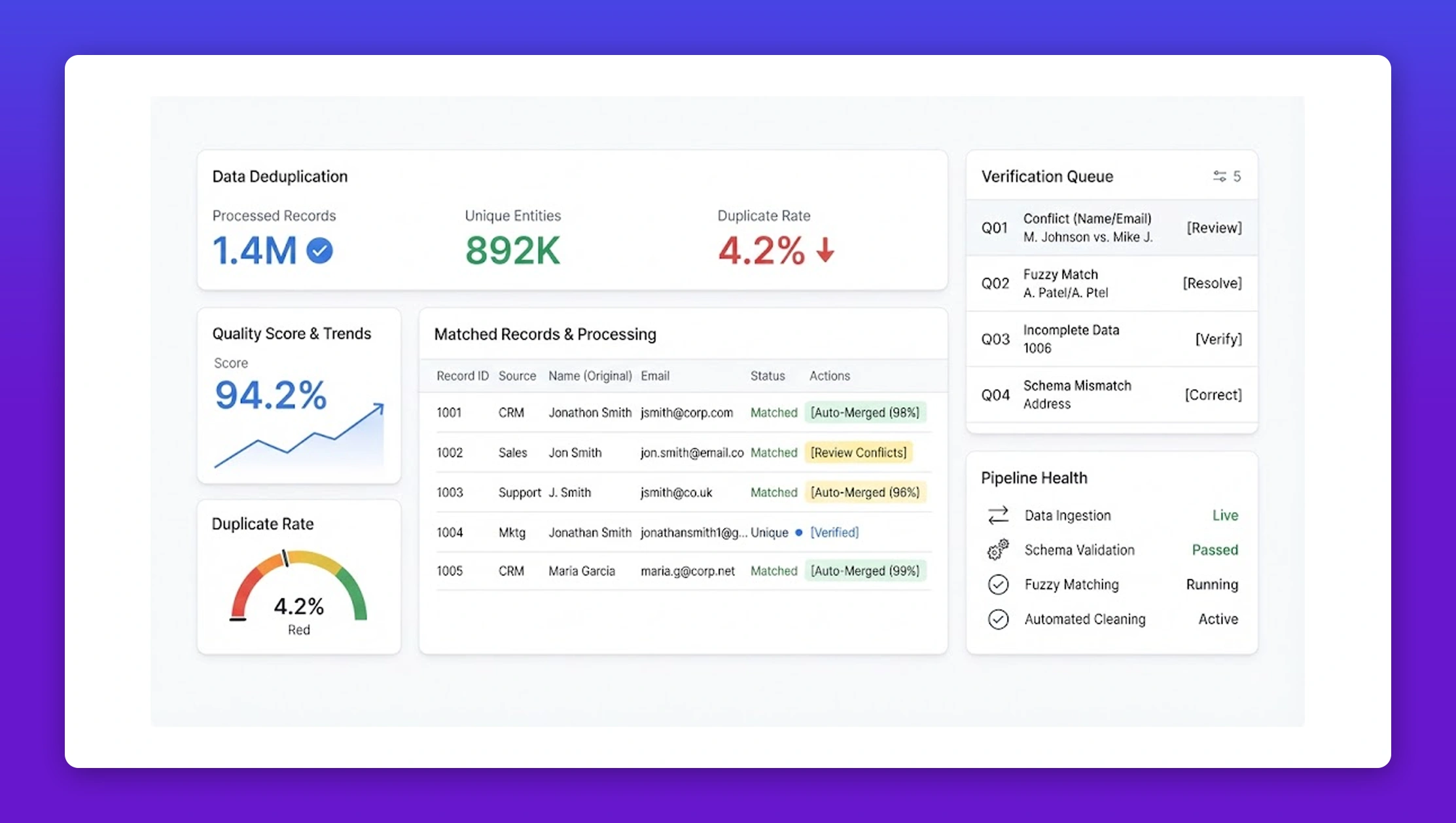
We designed a comprehensive deduplication and data cleaning architecture tailored specifically to the client's operational scale and data complexity. Central to this framework was establishing a reliable approach to How to Handle Duplicate Data in Web Scraping Projects that could operate continuously without manual oversight.
The solutions included:
- A multi-layer deduplication engine that identified and merged redundant records using fuzzy matching, exact-match rules, and field-level comparison logic simultaneously.
- Standardized schema enforcement that normalized incoming data formats before records entered the main pipeline, eliminating inconsistency at the source.
- Automated flagging workflows to detect conflicting attribute values and route them to a verification queue for rapid review.
- Integration of Data Visualization dashboards that displayed deduplication metrics, error rates, and data quality scores in real time for operational transparency.
- Scheduled audit routines that generated weekly reports on duplicate removal performance and pipeline health across all active scraping projects.
- Scalable cloud-based infrastructure ensuring the deduplication logic could handle sudden spikes in data volume without performance degradation.
These solutions worked together to transform a fragmented and unreliable pipeline into a consistent, high-quality data delivery system. The client gained full visibility into their data health and could finally trust the outputs generated by their scraping operations.
Structured Insights from the Deduplication Initiative
| Analysis Area | Project Goal | Approach Used | Result Achieved |
|---|---|---|---|
| Duplicate Record Detection | Eliminate redundant entries | Fuzzy + exact-match logic | 94% duplicate removal rate |
| Field Standardization | Normalize inconsistent formats | Schema enforcement layer | 3x faster data merges |
| Error Flagging | Identify conflicting attributes | Automated rule triggers | 80% reduction in manual reviews |
| Pipeline Performance | Maintain speed at scale | Cloud-based deduplication | Zero performance degradation |
| Audit Reporting | Track data quality over time | Weekly automated reports | Full lineage transparency |
This framework reflects a structured commitment to maintaining dataset integrity across every stage of the scraping and processing workflow. By identifying and resolving duplicate and inconsistent records systematically, businesses can shift their focus from data correction to data utilization. Applying Best Practices for Web Scraping Data Cleaning throughout the pipeline ensures that quality remains consistent even as data volumes grow significantly over time.
Operational teams benefit directly from the reduction in manual intervention, freeing resources to focus on strategic analysis rather than error correction. The audit reporting layer adds accountability and traceability, making it easier to demonstrate data reliability to stakeholders and compliance teams. Deploying Live Crawler Services further strengthens this approach by ensuring that freshly crawled data enters the pipeline already aligned with deduplication and standardization protocols.
Benefits of Choosing Web Fusion Data
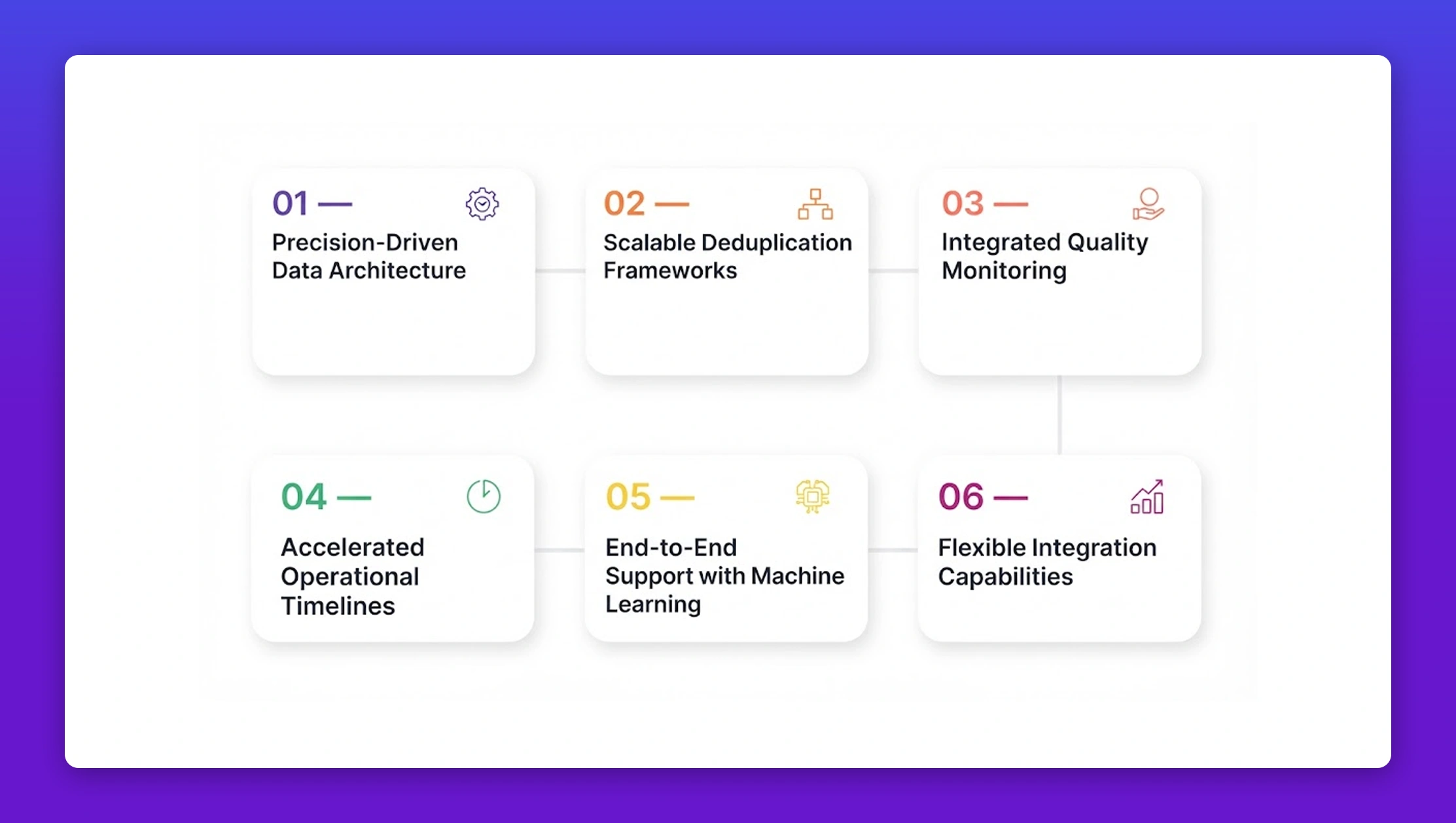
Choosing a data partner with deep expertise in quality management makes the difference between actionable intelligence and expensive misinformation. We bring proven methodologies and scalable infrastructure to every engagement.
-
Precision-Driven Data Architecture
Every pipeline built by us incorporates validation, deduplication, and consistency checks by default, ensuring that datasets delivered to clients are ready for immediate use without additional cleaning overhead. -
Scalable Deduplication Frameworks
Applying Best Ways to Clean Data After Web Scraping at enterprise scale requires more than basic scripts. We deploy adaptive logic that evolves with changing data structures and source variations across platforms. -
Integrated Quality Monitoring
Continuous monitoring ensures that data quality does not degrade over time. Clients receive automated alerts whenever error thresholds are exceeded, enabling immediate corrective action before downstream systems are affected. -
Accelerated Operational Timelines
By eliminating manual cleanup bottlenecks, clients experience faster data refresh cycles and reduced time-to-insight, allowing business teams to act on competitive intelligence without unnecessary delays. -
End-to-End Support with Machine Learning
We incorporate Machine Learning models to continuously improve duplicate detection accuracy, training on historical patterns to identify subtle redundancies that rule-based systems often miss. -
Flexible Integration Capabilities
Cleaned datasets integrate seamlessly with existing business intelligence platforms, data warehouses, and reporting tools, minimizing disruption while maximizing the immediate impact of improved data quality.
Client's Testimonial
Working with Web Fusion Data completely changed how we approach data quality. Understanding How to Handle Duplicate Data in Web Scraping Projects was something we knew we needed but could never implement properly on our own. The team built a system that now catches redundancies automatically, and our data accuracy has improved dramatically. Applying structured methods to Remove Duplicate Records From Scraped Datasets has saved us both time and significant operational costs.
– Head of Data Operations, E-Commerce Intelligence Group
Conclusion
This engagement demonstrated how a proactive, architecture-first approach to data quality can eliminate costly errors and restore confidence in scraped datasets at scale. Businesses that invest in understanding How to Handle Duplicate Data in Web Scraping Projects create a foundation where every downstream analysis, report, and decision is built on reliable information rather than noisy, redundant records.
Applying Best Practices for Web Scraping Data Cleaning across the full data lifecycle ensures that quality is not an afterthought but an embedded standard. Contact Web Fusion Data today to find out how our team can design a deduplication and data cleaning solution tailored to your specific operational scale, source diversity, and business intelligence requirements.