Introduction
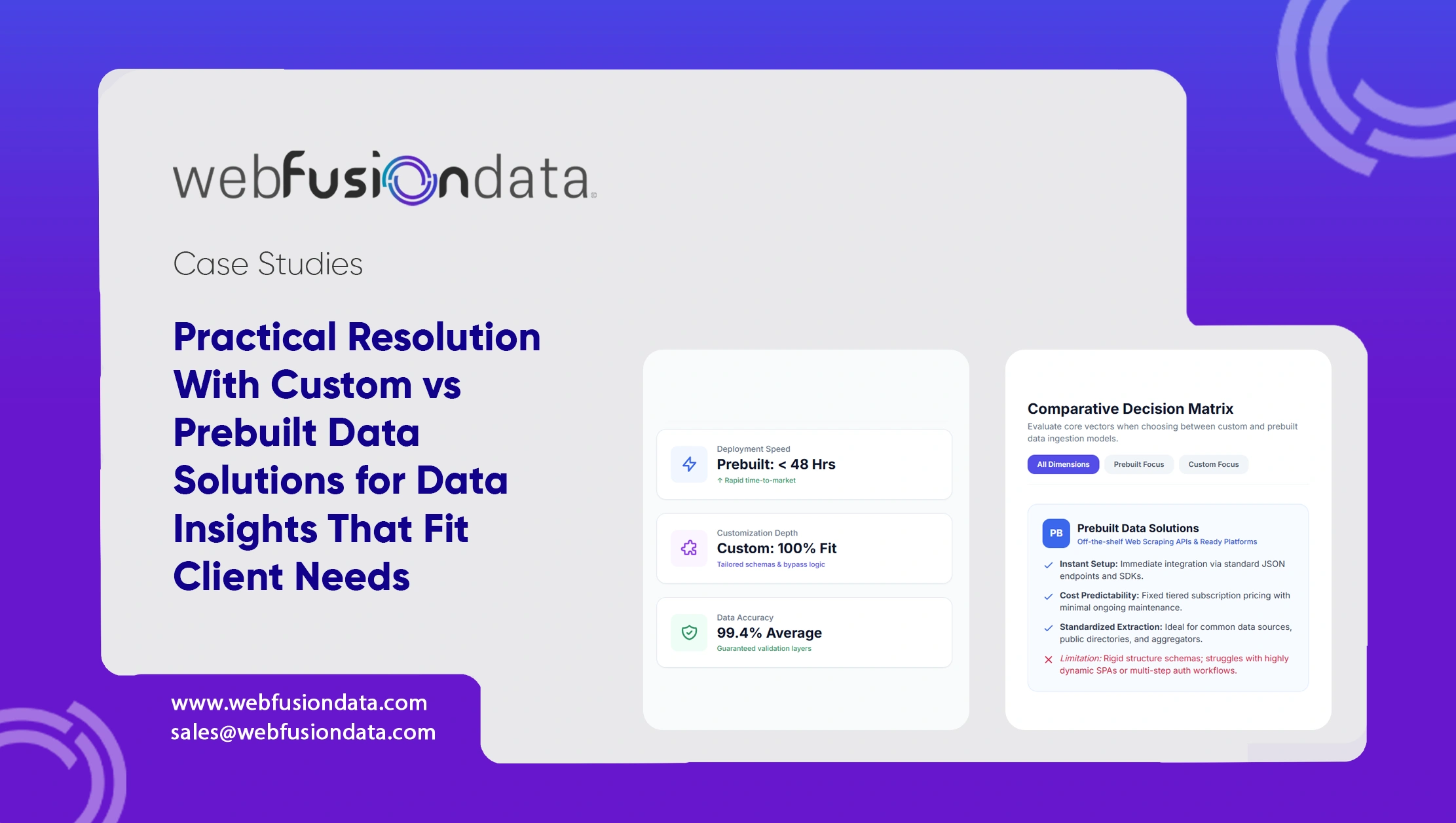
Businesses today are generating and consuming data at an unprecedented pace, making the right data collection strategy more critical than ever. When organizations are unable to match their operational complexity with an appropriate scraping approach, they inevitably face gaps in decision-making quality. Understanding Custom vs Prebuilt Data Solutions for Data Insights has become a central conversation for enterprises that want both agility and accuracy in how they collect, process, and act on web data.
The debate is not simply about technology preference but about fit. Every business has distinct requirements based on their industry, volume of data, frequency of collection, and depth of analysis needed. Through Web Scraping API Services, organizations can access both off-the-shelf capabilities and customized pipelines depending on what their operations truly demand, rather than settling for a generic approach that leaves critical data points unaddressed.
Choosing the right path requires a thorough evaluation of internal resources, timelines, and output expectations. Some organizations benefit from fast deployment using ready-made platforms, while others require deeply tailored configurations that prebuilt tools simply cannot accommodate. This case study walks through how we helped a client navigate that exact crossroads and arrive at a solution that genuinely fit their needs.
The Client Story
A mid-sized analytics firm serving multiple retail and hospitality clients came to us with a pressing challenge. Their data pipelines were inconsistent, producing incomplete or delayed outputs that affected the quality of reports they delivered to their own clients. They needed a structured evaluation of Enterprise Data Collection Custom vs Ready-Made Web Scraping Solutions to determine which approach would resolve their ongoing data reliability issues without inflating operational costs.
The firm operated across five industry verticals, each with different website structures, update frequencies, and data sensitivity levels. This complexity meant that a single prebuilt tool could not uniformly serve all use cases. To Scrape Real-Time Custom vs Prebuilt Data Solutions effectively, the team required a framework that could adapt dynamically, handling structured e-commerce pages as efficiently as semi-structured hospitality portals and review platforms.
Their internal team had limited development bandwidth, meaning any solution also needed to consider implementation ease and long-term maintainability. We conducted a thorough requirements assessment covering data types, scraping frequency, integration needs, and compliance boundaries. With a clear picture of what was needed, the team moved forward with a hybrid recommendation that addressed both immediate performance gaps and future scalability requirements.
The Challenges
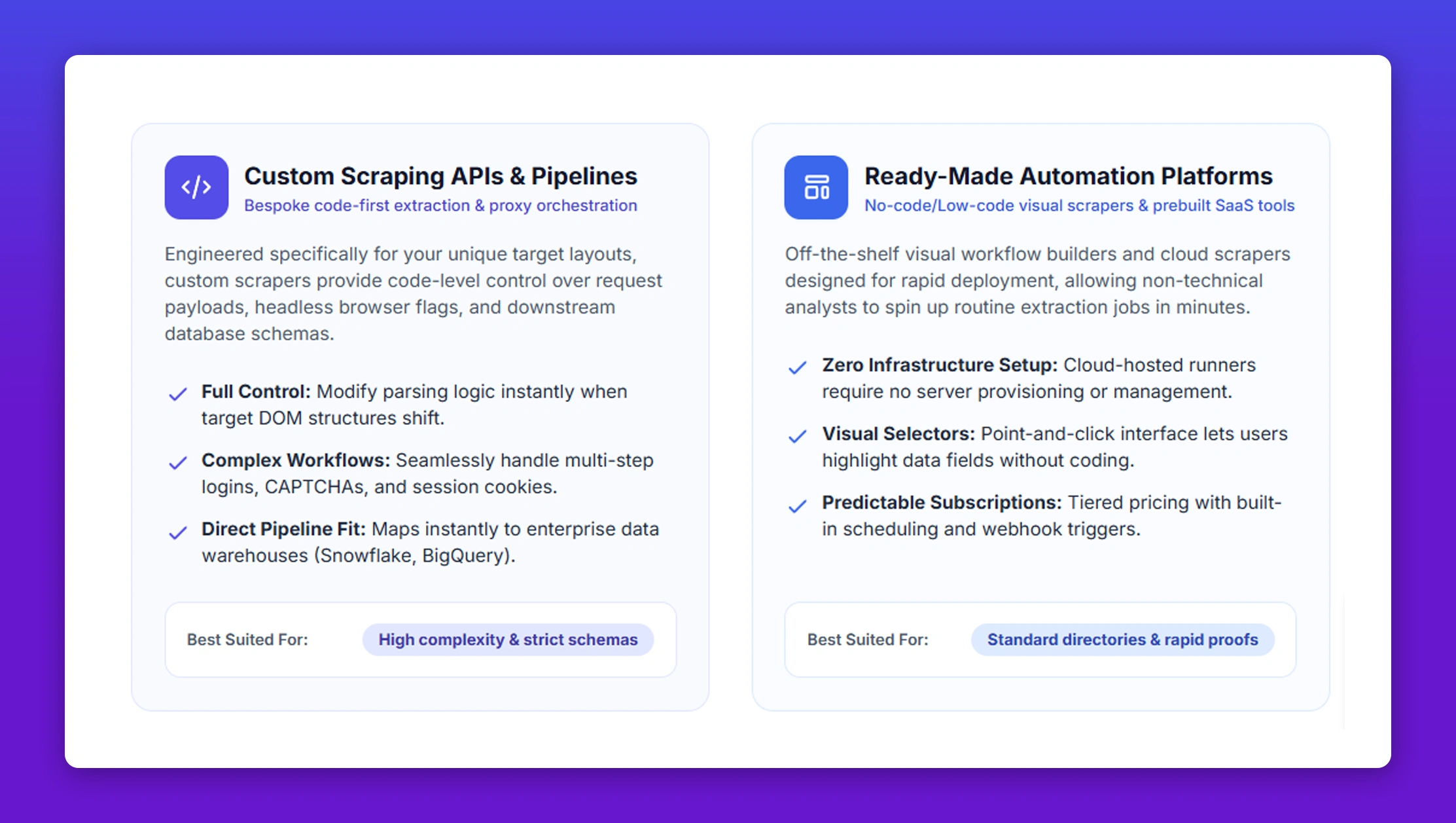
Despite their best efforts, the client's existing setup showed significant structural weaknesses that were becoming increasingly difficult to ignore. The combination of mismatched tools and inconsistent data outputs was creating downstream problems that affected client deliverables and internal planning cycles.
Key obstacles they encountered included:
- Prebuilt scraping tools lacked the flexibility to handle dynamic JavaScript-heavy pages across retail websites, resulting in data loss.
- Inability to Compare Custom Scraping APIs and Ready-Made Automation Platforms objectively, leading to poor tool selection decisions in the past.
- Data refresh cycles were too slow for real-time reporting requirements in the hospitality vertical.
- No centralized system existed to manage credentials, proxy rotation, or rate-limiting across multiple scraping environments.
- Enterprise Web Scraping Solutions for Data Collection were either too rigid in structure or too expensive without offering the configurability the client needed.
- Reporting inconsistencies created by mismatched data schemas made dashboard integration unnecessarily complex.
These issues compounded over time, creating a backlog of unreliable datasets that required manual correction before use. Without a strategic overhaul, the firm risked losing client contracts due to continued reporting delays and inaccuracies. The situation demanded not just a technical fix but a comprehensive rethinking of their entire data acquisition framework.
The Solutions
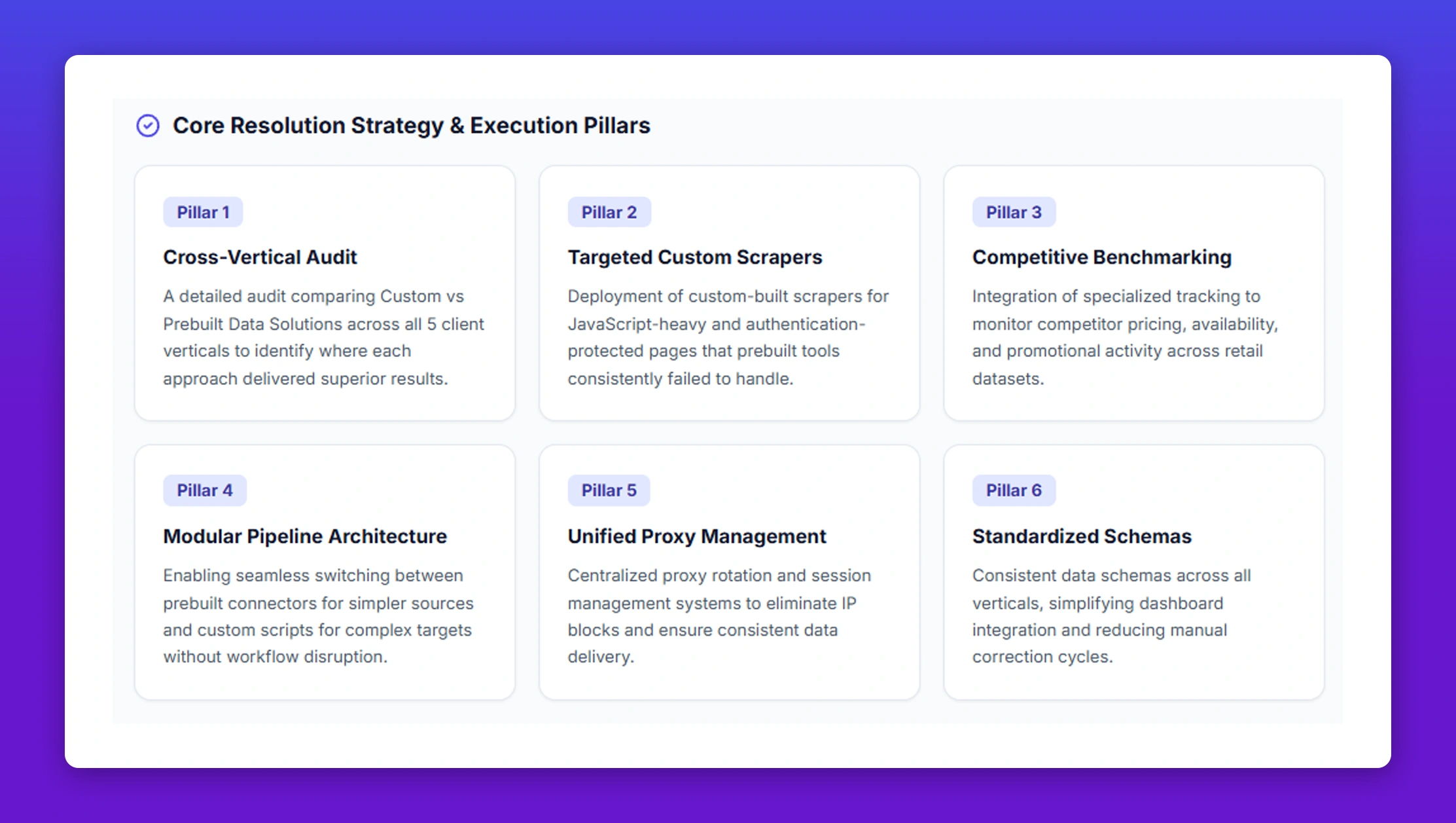
We approached this engagement by first establishing a clear benchmark of current performance before designing any replacement architecture. The goal was to ensure the solution addressed the root causes rather than applying surface-level patches that would eventually fail under load.
The resolution strategy included:
- A detailed audit comparing Custom vs Prebuilt Data Solutions for Data Insights across all five client verticals to identify where each approach delivered superior results.
- Deployment of custom-built scrapers for JavaScript-heavy and authentication-protected pages that prebuilt tools consistently failed to handle.
- Integration of Competitive Benchmarking Services to track competitor pricing, product availability, and promotional activity across retail datasets.
- A modular pipeline architecture allows the client to switch between prebuilt connectors for simpler sources and custom scripts for complex targets without disrupting the overall workflow.
- Unified proxy and session management systems to eliminate blocks and ensure consistent data delivery across all scraping environments.
- Standardized data schemas across all verticals, simplifying dashboard integration and reducing manual correction cycles by a significant margin.
This layered approach meant the client could now manage their entire data operation from a single governance framework, regardless of whether the underlying collection method was custom-built or off-the-shelf. The architecture was designed to scale as new client verticals were onboarded without requiring full rebuilds.
From Raw Data to Reliable Intelligence
| Evaluation Dimension | Assessment Goal | Approach Used | Result Delivered |
|---|---|---|---|
| Source Complexity Rating | Classify scraping difficulty | Multi-layer site analysis | 94% source coverage achieved |
| Pipeline Reliability Score | Reduce data failure rate | Custom fault-tolerant design | Failures reduced by 78% |
| Data Refresh Speed | Meet real-time reporting needs | Incremental crawling setup | Refresh cycles cut to under 8 min |
| Schema Consistency Rate | Unify cross-vertical outputs | Standardized field mapping | 100% dashboard-ready outputs |
| Cost-Per-Record Efficiency | Optimize scraping spend | Hybrid tool allocation | 41% reduction in per-record cost |
This structured evaluation model allowed the client to move away from guesswork and into measurable, repeatable performance tracking. Enterprise Web Scraping Solutions for Data Collection work best when they are benchmarked continuously against defined KPIs rather than assessed only during incident reviews.
Additionally, applying Enterprise Web Crawling across the client's most complex source environments ensured that even deeply nested or dynamically rendered content was captured accurately. The combination of precision benchmarking and intelligent crawling architecture gave the client the kind of operational confidence their previous setup had never delivered.
Benefits of Choosing Web Fusion Data
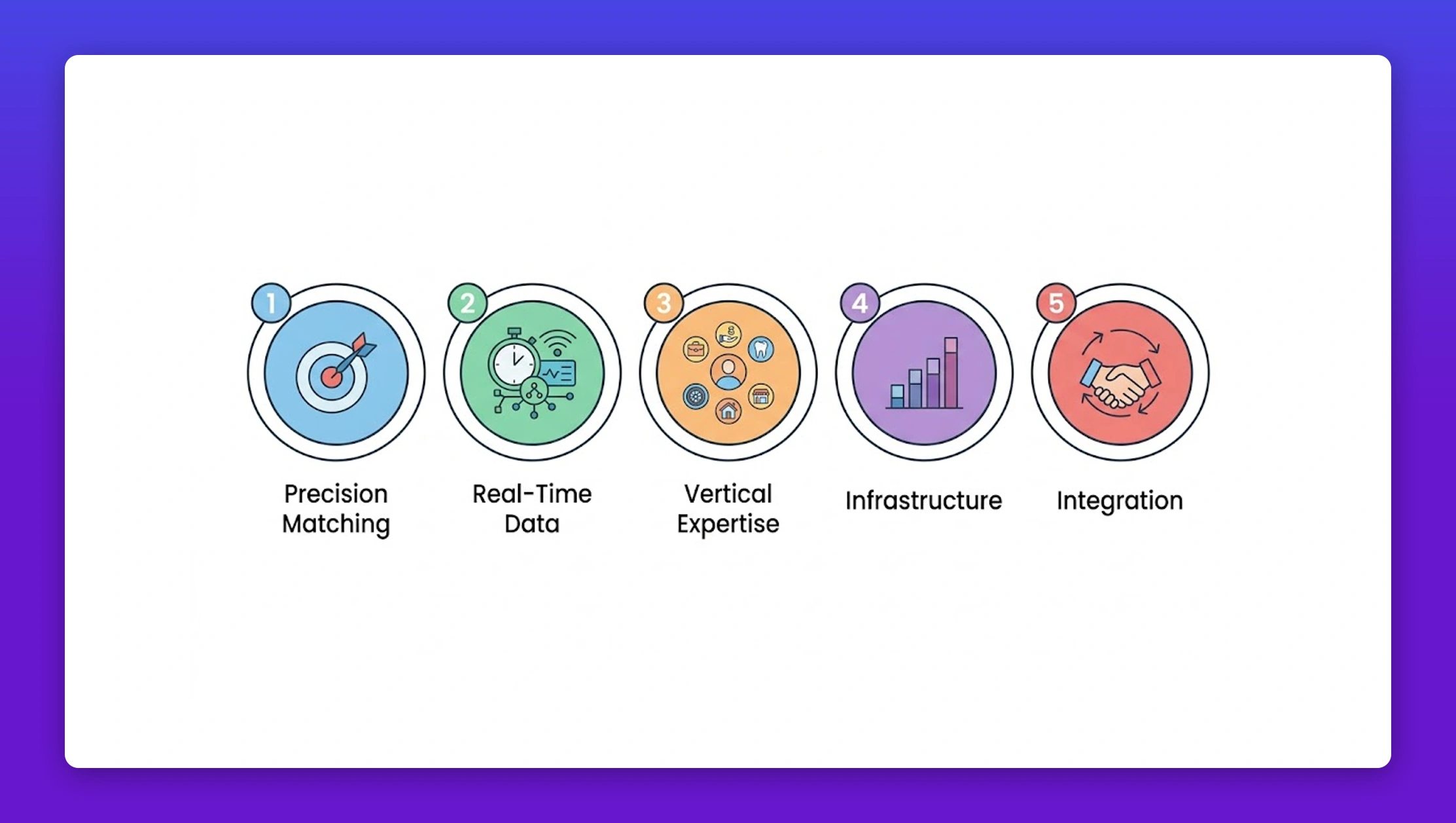
Selecting the right data partner is as important as selecting the right technology. We combine technical depth with strategic advisory capabilities, helping clients not just build scraping systems but build the right ones for their specific context.
-
Precision in Solution Matching
Every engagement begins with a structured needs analysis that evaluates source complexity, refresh frequency, and output format requirements, ensuring that Enterprise Data Collection Custom vs Ready-Made Web Scraping Solutions decisions are always grounded in actual operational data. -
Reliable Real-Time Data Delivery
Using Live Crawler Services, clients receive continuous, up-to-date data streams that support real-time dashboards, operational alerts, and time-sensitive market analysis without lag or data drift. -
Cross-Vertical Expertise
With experience spanning retail, hospitality, finance, and logistics, we bring vertical-specific knowledge that generic scraping platforms cannot replicate, allowing for smarter targeting and cleaner data outputs. -
Scalable Infrastructure Management
Proxy rotation, session handling, rate-limit compliance, and anti-bot mitigation are managed proactively, ensuring that Scrape Real-Time Custom vs Prebuilt Data Solutions continue performing reliably even as source websites evolve. -
End-to-End Integration Support
From raw data extraction to cleaned, schema-normalized datasets ready for analytics platforms, we manage the complete pipeline, reducing the burden on the client's internal teams significantly.
Client's Testimonial
Working with Web Fusion Data changed how we think about data collection entirely. Their ability to evaluate Custom vs Prebuilt Data Solutions for Data Insights for each of our verticals gave us a solution that was genuinely tailored rather than off-the-shelf. The improvement in data reliability and Compare Custom Scraping APIs and Ready-Made Automation Platforms clarity has directly strengthened the reports we deliver to our own clients. This is the kind of partnership that actually moves the needle.
– Head of Data Operations, Multi-Vertical Analytics Firm
Conclusion
This engagement illustrated that data collection success is rarely about choosing the most advanced tool available but about choosing the most appropriate one for each specific context. Custom vs Prebuilt Data Solutions for Data Insights is not a binary choice between two extremes but a spectrum that demands careful evaluation based on source complexity, business goals, and available resources.
Contact Web Fusion Data today to schedule a detailed consultation where our team will assess your current setup, identify performance gaps, and design a data acquisition strategy built specifically around your business requirements. Compare Custom Scraping APIs and Ready-Made Automation Platforms decisions made without proper assessment often lead to either over-engineered systems that drain resources or underpowered setups that create data gaps.