Introduction
Modern businesses collect large volumes of information from product pages, marketplaces, travel portals, directories, and other online sources. However, scraped records often contain duplicate entries, missing values, inconsistent structures, and irrelevant fields. Processing these records manually can create delays and increase the effort required before the information becomes suitable for analysis.
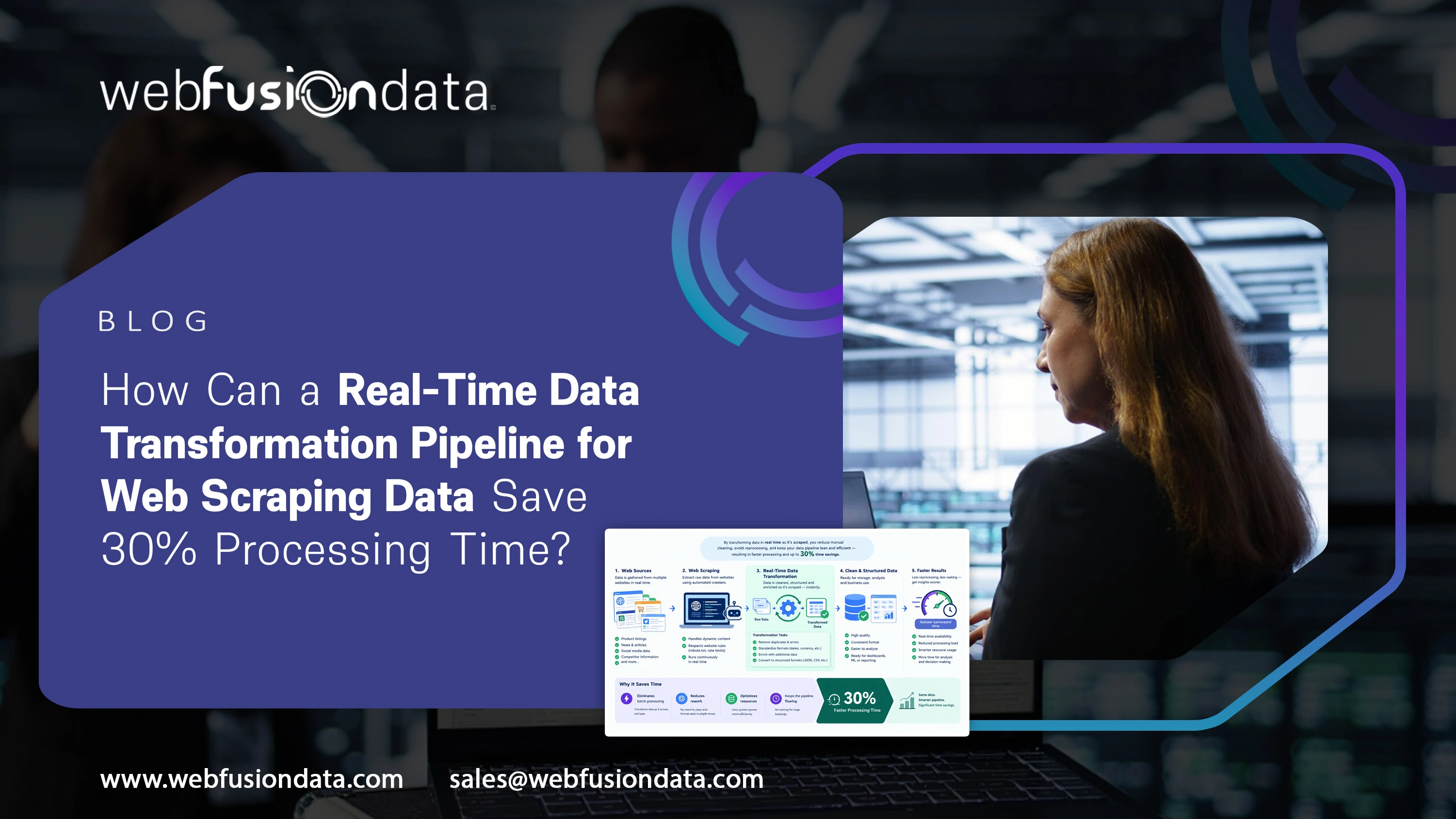
A Real-Time Data Transformation Pipeline for Web Scraping Data helps address these challenges by transforming incoming records continuously. Instead of waiting for large batches to accumulate, organizations can apply validation, cleaning, formatting, and standardization rules as information arrives. This approach can reduce repetitive processing and improve the consistency of downstream datasets.
When combined with Web Scraping Solutions, automated transformation can create a smoother path between data collection and analytical use. Businesses can prepare information for databases, dashboards, reporting systems, and machine learning applications while maintaining structured records. The stated benchmark of 30% faster processing demonstrates how efficient transformation can contribute to more responsive data workflows.
Precision First: Streamlining Raw Records for Faster Data Processing

Raw scraped information rarely arrives in a format that can immediately support business analysis. Different websites may use different naming conventions, measurement units, date formats, category structures, and field arrangements. A structured preparation layer can identify these variations early and apply consistent rules before the information moves toward storage or analytics.
This reduces repeated cleanup activities later in the workflow and creates a more predictable processing sequence for teams handling large datasets. A well-organized preparation strategy can also establish clear transformation stages covering validation, normalization, deduplication, enrichment, and error handling. When organizations evaluate How to Build a Data Transformation Pipeline for Scraped Data, these stages provide a practical foundation for deciding where each transformation should occur.
Processing rules can be customized according to source characteristics, business requirements, and the expected structure of the final dataset. For high-volume environments, processing efficiency becomes increasingly important because even small delays can multiply across millions of records. Organizations working with Big Data and Advanced Analytics can benefit from automated preparation because standardized records require fewer corrective actions before analytical workloads begin.
Key preparation activities can include:
- Removing duplicate records automatically
- Standardizing inconsistent field formats
- Validating mandatory data attributes
- Filtering irrelevant information
- Flagging incomplete records
- Applying predefined transformation rules
| Processing Area | Operational Impact |
|---|---|
| Validation | Identifies incorrect records |
| Normalization | Creates consistent values |
| Deduplication | Removes repeated entries |
| Filtering | Limits unnecessary information |
| Enrichment | Adds useful contextual fields |
These improvements create a cleaner foundation for subsequent processing while helping teams reduce unnecessary manual intervention. Continuous validation can also identify incomplete or malformed records earlier, preventing poor-quality information from moving deeper into the workflow.
Strategic Momentum: Turning Fresh Data Into Timely Business Intelligence

Businesses monitoring rapidly changing online information need more than accurate collection. They also need information to become usable quickly. Price movements, product availability, customer ratings, promotional activity, and competitor changes can lose analytical value when processing delays separate collection from interpretation. Continuous transformation helps shorten this gap by preparing incoming records as part of the collection workflow.
A structured transformation process can organize information according to predefined schemas, making records easier to compare across websites and categories. With Market Research and Insight Analysis, businesses can use consistently prepared information to evaluate market movements, compare competitor activities, and identify changes across monitored sources.
Another important consideration is how information travels between extraction, transformation, storage, and analytics environments. An End-To-End Data Pipeline Architecture for Scraped Data can establish connected stages that reduce unnecessary movement and repeated formatting. When transformation rules are incorporated into the broader workflow, records can reach databases and analytical applications in a more usable condition.
Practical improvements can include:
- Faster preparation of incoming records
- Consistent formatting across sources
- Earlier identification of data anomalies
- More responsive analytical reporting
- Reduced dependency on manual correction
- Better synchronization between processing stages
| Data Challenge | Transformation Response |
|---|---|
| Different formats | Standardized structures |
| Missing attributes | Validation and flagging |
| Repeated records | Duplicate identification |
| Changing values | Continuous processing |
| Source variations | Rule-based normalization |
Together, these practices can improve the speed at which freshly collected information becomes suitable for reporting and business intelligence activities.
Future-Ready Foundations: Building Reliable Workflows for Continuous Data Growth

As scraping operations expand across websites, regions, categories, and product groups, transformation workflows must handle increasing volumes without becoming bottlenecks. A scalable architecture can divide processing into manageable stages, allowing validation, transformation, error handling, and storage activities to operate systematically. This structure also makes it easier to identify processing issues without disrupting the entire workflow.
Organizations managing Enterprise Web Crawling environments often deal with diverse source structures and frequent changes. A flexible transformation layer can accommodate these differences through configurable rules rather than relying on repeated manual adjustments. This makes the workflow more adaptable when websites change layouts, introduce new fields, or modify the way information is presented.
Reliable delivery also depends on establishing appropriate extraction, transformation, and storage sequences. Businesses evaluating Extract ETL Pipelines for Scraped Data Analytics can structure these stages around their analytical requirements while maintaining clear movement between source records and final datasets. Monitoring mechanisms can further identify failed transformations, unexpected values, or processing delays before they affect downstream applications.
A scalable workflow can provide several operational advantages:
- Handles increasing record volumes
- Separates failed records for review
- Supports configurable transformation rules
- Simplifies workflow monitoring
- Reduces processing bottlenecks
- Improves consistency across multiple sources
| Workflow Component | Main Responsibility |
|---|---|
| Ingestion | Receives collected records |
| Processing | Applies transformation rules |
| Quality control | Checks record accuracy |
| Error management | Isolates problematic entries |
| Storage | Maintains processed information |
By combining structured processing with monitoring and scalable architecture, organizations can maintain reliable data flows even as collection volumes and source diversity continue to increase.
How Web Fusion Data Can Help You?
Businesses need a reliable process that turns continuously collected online information into structured, usable datasets. We can help organizations design transformation workflows around their collection sources, data formats, processing requirements, and analytical objectives. A Real-Time Data Transformation Pipeline for Web Scraping Data can bring validation, standardization, cleaning, and quality checks closer to the collection stage.
Key ways we can support these workflows include:
- Automating repetitive data preparation activities
- Standardizing information collected from different sources
- Applying customized validation and transformation rules
- Identifying duplicates and inconsistent records
- Supporting structured delivery for analytical systems
- Creating scalable workflows for growing data volumes
A properly structured workflow can reduce unnecessary manual intervention while helping businesses maintain consistent information across databases, dashboards, cloud platforms, and business intelligence environments. It can also make transformation processes easier to monitor, maintain, and adjust as source structures change.
Organizations can further strengthen their operational framework by evaluating How to Build a Data Transformation Pipeline for Scraped Data and adapting its principles to their own collection environment. We can support the planning of transformation stages, quality controls, processing logic, and structured data delivery so teams can move from raw records toward reliable analytical datasets more efficiently.
Conclusion
Efficient transformation can make a significant difference when organizations process large and continuously changing volumes of scraped information. A Real-Time Data Transformation Pipeline for Web Scraping Data helps bring cleaning, validation, normalization, and formatting into a streamlined workflow, reducing repetitive processing while supporting more consistent datasets and faster analytical readiness.
A structured approach also provides a foundation for scalable data operations as collection requirements expand. Building an Analytics-Ready Scraped Data Pipeline can help connect transformed records with reporting, analytics, and business intelligence environments while maintaining a dependable flow of information. Connect with Web Fusion Data today to build a faster, cleaner, and more reliable data transformation workflow.