Introduction
Retail businesses today operate in a landscape where pricing decisions can either strengthen or erode margins within hours. Consumer expectations shift rapidly, and competitors adjust their strategies with increasing speed. Real-Time Retail Price Optimization Using Web Scraping Data has emerged as a critical capability for brands that want to make smarter decisions without relying on guesswork or delayed reporting.
Retailers that depend on periodic pricing reviews often miss micro-shifts in the market that directly affect their revenue potential. Working with accurate and continuously refreshed Grocery Datasets helps businesses build a clearer picture of what consumers are paying across different platforms and regions. This kind of visibility allows category managers and pricing analysts to act on facts rather than assumptions, making every pricing call more deliberate and defensible.
The demand for competitive intelligence has grown beyond large enterprises. Retail Competitor Pricing Intelligence Through Scraping provides these organizations with a structured, scalable way to benchmark themselves without the overhead of manual data collection. When this intelligence is embedded into daily workflows, it creates a consistent foundation for margin improvement and strategic growth.
The Client Story
A fast-growing retail chain with operations across multiple geographies approached us with a clearly defined problem — their pricing team was spending more time collecting data than actually using it. Despite having a capable analytics function, they lacked a reliable and automated source of competitor pricing that could feed into their existing tools. They needed Real-Time Retail Price Optimization Using Web Scraping Data to solve what had become a recurring bottleneck in their pricing cycle.
The client's product catalog spanned thousands of SKUs across grocery, household, and personal care categories. Price changes in even a small subset of these categories had measurable downstream effects on overall margin performance. Competitive Pricing Intelligence Using Web Scraping for Retail Data was identified as the solution that could close the gap between what they knew and what they needed to act on.
Beyond the immediate pricing function, the client was also building toward a broader market intelligence initiative. Enabling Automated Retail Price Monitoring Using Web Scraping across their full product range would give their pricing, merchandising, and procurement teams a shared, reliable data layer to work from, reducing internal friction and enabling faster cross-functional decisions.
The Challenges
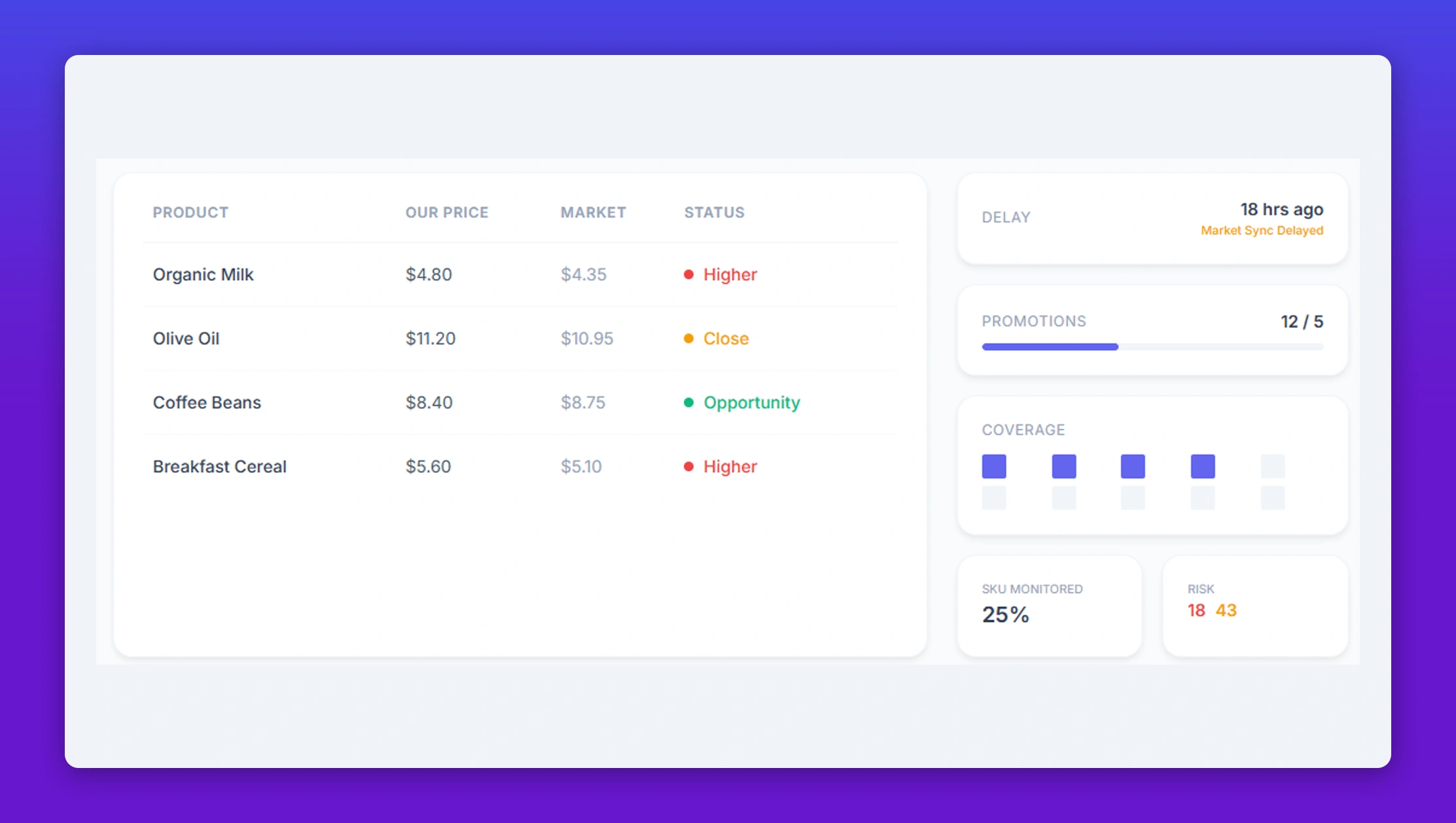
Before engaging with us, the client's internal processes created more confusion than clarity. Their pricing team relied on a patchwork of spreadsheets, vendor portals, and occasional spot checks to monitor the market. This approach introduced inconsistencies and time lags that made their data unreliable precisely when accurate information was most valuable, during promotions, product launches, and seasonal demand peaks.
A key frustration was the inability to act on competitor pricing signals in a timely manner. By the time data was gathered, cleaned, and reviewed, the market had already moved. Competitive Pricing Intelligence Using Web Scraping for Retail Data was something they recognized as critical, but building it internally had proven difficult due to technology gaps and resource constraints.
Key challenges the client encountered included:
- Inconsistent data collection frequencies leading to pricing decisions based on outdated market information.
- No centralized visibility into competitor promotional cycles or discount patterns.
- Difficulty scaling Automated Retail Price Monitoring Using Web Scraping across thousands of SKUs without significant manual intervention.
- Limited ability to benchmark regional pricing variations due to fragmented data sources.
- No structured approach to identifying margin erosion caused by competitor undercutting.
These gaps had a direct financial impact. The client was either over-pricing in categories where competitors had become aggressive, or under-pricing in segments where they could have commanded higher margins. Without a reliable intelligence framework, every pricing decision carried unnecessary risk.
The Solutions
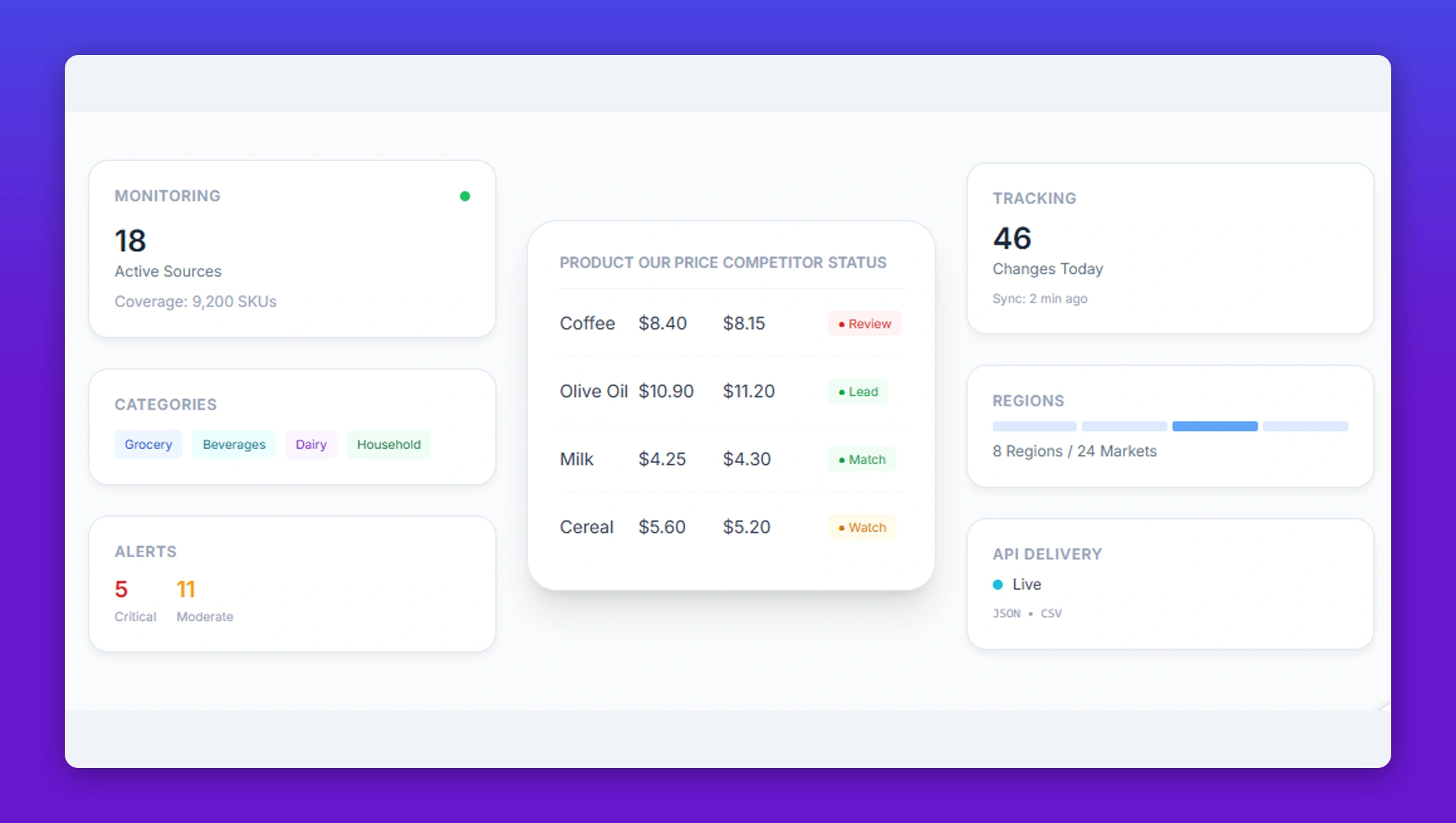
We designed a purpose-built data pipeline tailored to the client's catalog structure, pricing cadence, and analytical infrastructure. The goal was not just to deliver data but to deliver it in a form that could immediately plug into the client's existing pricing tools, reducing time-to-insight and enabling faster execution.
The solutions we delivered included:
- A fully automated scraping architecture that enabled Real-Time Retail Price Optimization Using Web Scraping Data at scale, covering thousands of SKUs across multiple competitor platforms simultaneously.
- Structured data delivery in formats compatible with the client's BI and pricing systems, eliminating manual transformation steps.
- Deployment of Price Tracking Services to monitor both standard and promotional prices, capturing time-stamped changes that revealed competitor pricing behavior over extended periods.
- Implementation of category-level dashboards allowing pricing managers to view competitive positioning by product group, region, and retailer.
- Integration of alerting mechanisms that flagged significant price movements in high-priority SKUs, enabling rapid response without requiring constant manual monitoring.
- Application of Retail Market Intelligence Using Scraped Data for API delivery, ensuring seamless and scalable data flow into the client's internal systems without infrastructure disruption.
Together, these components created a cohesive intelligence layer that gave the client clarity, speed, and confidence in their pricing process. Every data point was traceable, timestamped, and structured for immediate use.
Benefits of Choosing Web Fusion Data
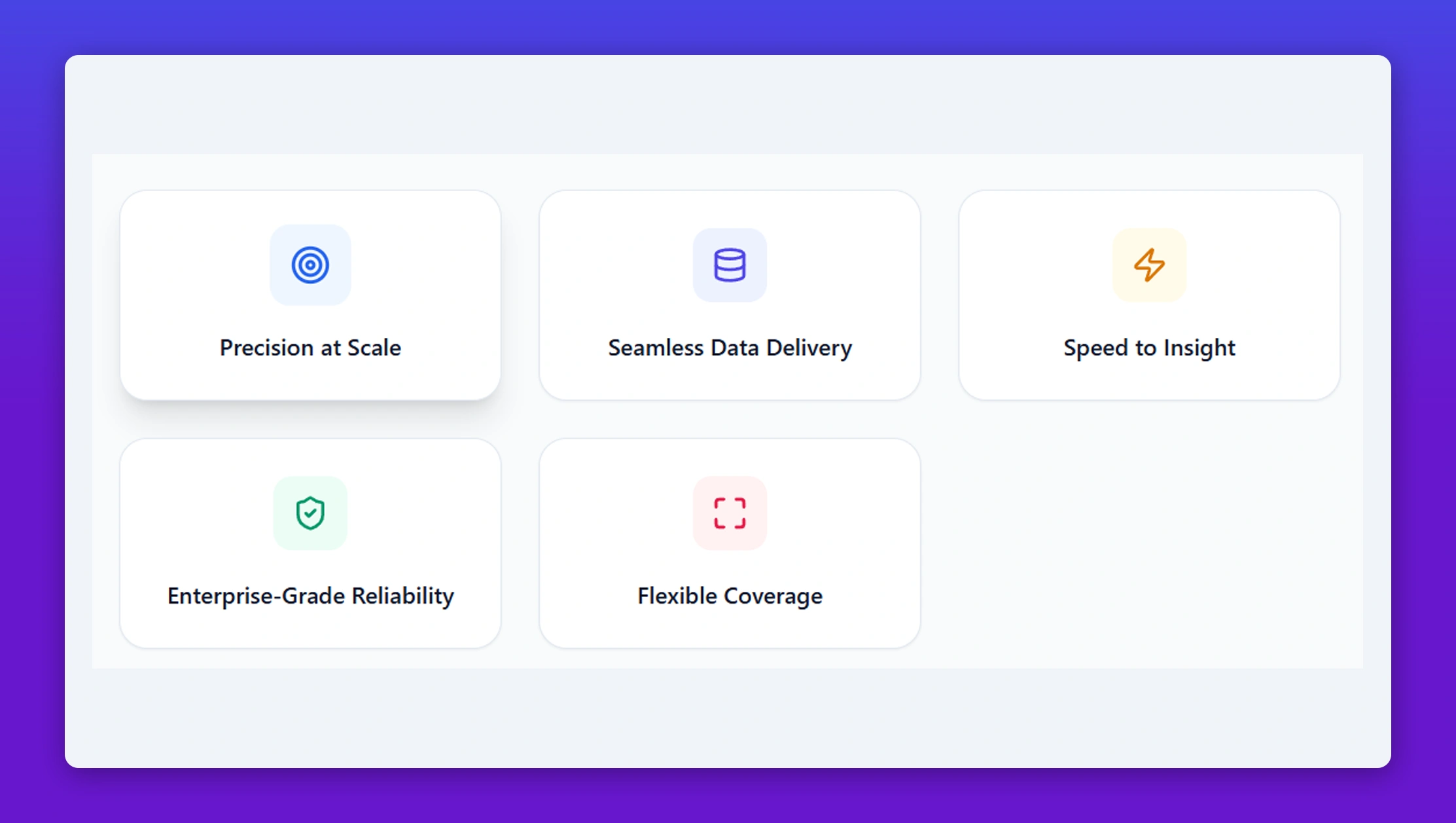
Selecting the right data partner goes beyond technical capability, it requires a partner who understands retail dynamics, margin pressures, and the operational realities pricing teams face daily.
-
Precision at Scale
Leveraging Retail Competitor Pricing Intelligence Through Scraping, our systems capture accurate price points across thousands of products and dozens of retailers, ensuring that every insight is grounded in verified, current market data. -
Seamless Data Delivery
Our API-first architecture, powered by Retail Market Intelligence Using Scraped Data for API, allows clients to receive structured datasets directly into their existing platforms — no intermediary steps, no data quality compromises. -
Speed to Insight
Pricing windows are narrow. Our automated pipelines reduce the time between data capture and decision-making, ensuring clients can respond to market movements before margin opportunities are lost. -
Enterprise-Grade Reliability
Using Enterprise Web Crawling infrastructure, our solutions maintain consistent performance even when monitoring high-volume, frequently updated retail pages across multiple geographies. -
Flexible Coverage
Whether clients need national pricing benchmarks or hyper-local competitor tracking, our systems adapt to the geographic scope and category depth their strategies require.
Retail Pricing Intelligence: Outcomes at a Glance
| Intelligence Area | Business Goal | Approach Used | Result Achieved |
|---|---|---|---|
| Competitor Price Tracking | Close pricing gaps | Automated multi-retailer monitoring | 18% reduction in reactive markdowns |
| Promotional Pattern Analysis | Anticipate discount cycles | Time-series price capture | 22% improvement in promo planning accuracy |
| SKU-Level Benchmarking | Optimize individual product margins | Category-specific extraction | 14% average margin improvement per category |
| Regional Price Variance | Align geo-specific pricing | Location-filtered data collection | Consistent pricing strategy across 9 markets |
| Private Label Monitoring | Counter low-cost competition | Targeted brand and label tracking | Faster competitive response within 24 hrs |
This structured view illustrates how targeted data collection translates into measurable business outcomes. Each intelligence area feeds directly into a pricing action reducing the distance between observation and execution.
Retail Competitor Pricing Intelligence Through Scraping gives businesses the ability to move from reactive to proactive pricing management, identifying patterns before they become problems. Paired with Automated Retail Price Monitoring Using Web Scraping, teams gain the operational rhythm necessary to respond consistently and confidently to market changes at any scale.
Client's Testimonial
Working with Web Fusion Data gave our pricing team something they had been asking for years, a reliable, automated feed of competitor pricing data that was accurate enough to act on immediately. Real-Time Retail Price Optimization Using Web Scraping Data went from being a concept on our roadmap to a live capability embedded in our daily operations. The structured delivery through Dynamic Pricing Services made integration with our existing systems seamless and efficient.
– Head of Pricing Strategy, National Retail Group
Conclusion
The outcomes of this engagement reinforced a straightforward principle; retailers who invest in structured, continuous market intelligence consistently outperform those who rely on periodic reviews and manual processes. By embedding Real-Time Retail Price Optimization Using Web Scraping Data into daily operations, the client moved from reactive pricing to a forward-looking strategy that directly contributed to stronger margins and improved competitive positioning.
Competitive Pricing Intelligence Using Web Scraping for Retail Data gave the client the visibility they needed to make pricing decisions rooted in current market reality rather than historical assumptions. Contact Web Fusion Data today to discuss how we can design a pricing intelligence framework that fits your catalog, your systems, and your competitive environment, delivering the margin improvements your business deserves.