Introduction
Quick commerce has changed how FMCG brands monitor grocery prices, discounts, availability, and consumer-facing offers. Blinkit, Zepto, and Instamart frequently adjust prices based on demand, location, inventory, and promotional activity. Scrape Real-Time Price Intelligence for Quick Commerce helps businesses build a structured view of these changing market conditions.
For FMCG companies, manual monitoring across multiple platforms can create inconsistent records and delayed insights. Automated collection provides product names, listed prices, selling prices, discounts, pack sizes, availability, and promotional details at scale. This supports Grocery Data Scraping & Quick Commerce Intelligence in India for broader market monitoring.
A unified dataset also makes cross-platform comparisons easier. Brands can identify pricing gaps, changing discount patterns, product-level differences, and marketplace-specific movements without repeatedly checking individual applications. With organized historical records, analysts can evaluate pricing trends and create practical intelligence for competitive benchmarking and assortment planning.
Strategic Blinkit Signals Strengthening Quick Commerce Price Monitoring
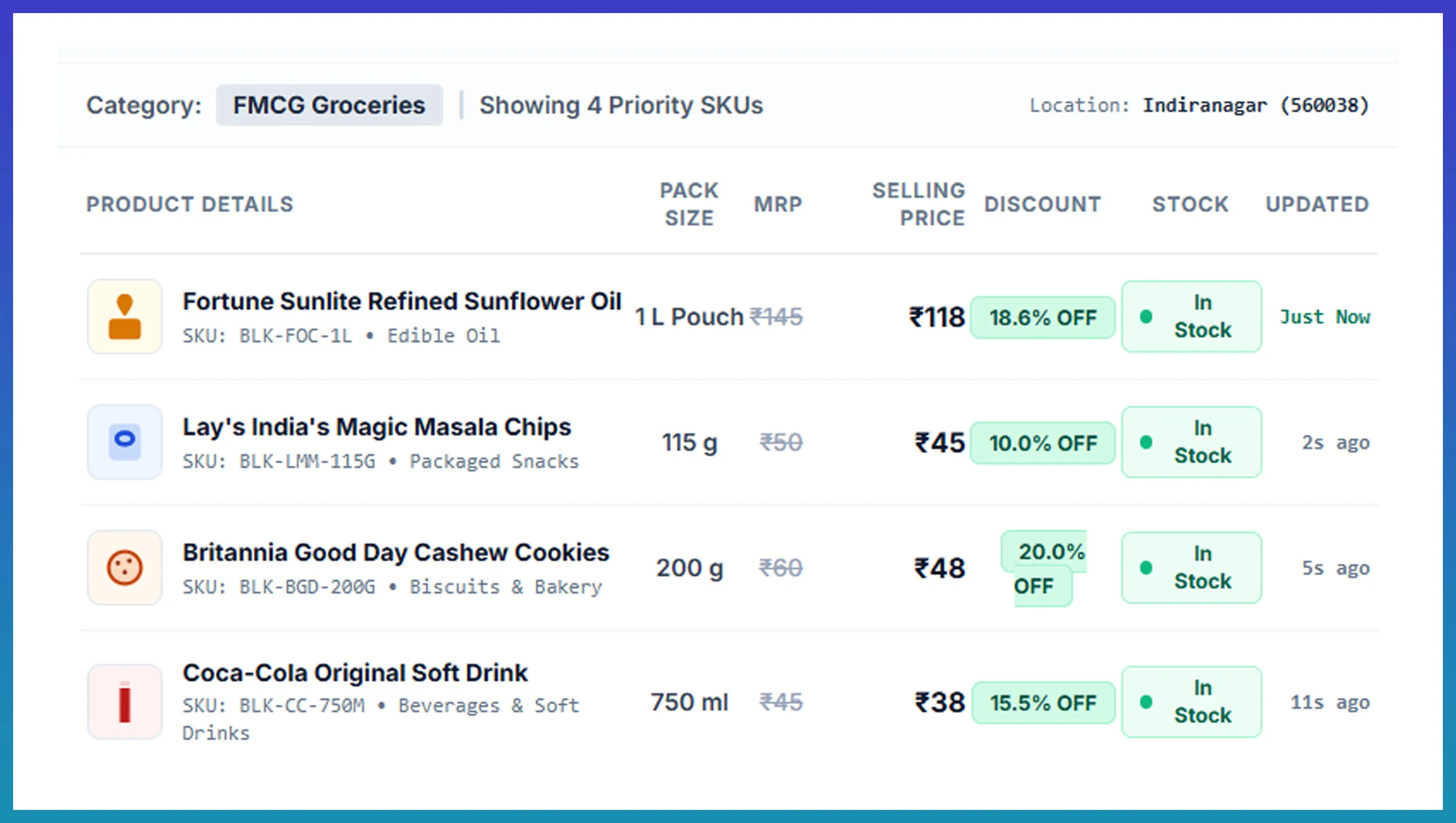
Quick commerce pricing can fluctuate throughout the day as promotions, stock conditions, seller activity, and regional demand change. For FMCG brands, comparing these movements across marketplaces provides a clearer view of competitive positioning. Blinkit vs Zepto vs Instamart Price Comparison for Data Extraction can organize comparable product records by title, category, pack size, listed price, selling price, discount, and availability. This structure makes cross-platform observations easier to evaluate without depending on scattered manual records.
A dedicated collection process can also organize Blinkit Datasets around product-level attributes and recurring price observations. Instead of reviewing individual listings repeatedly, analysts can maintain structured records containing product identifiers, package details, current prices, promotional values, and availability signals. Repeated collection at scheduled intervals creates a historical reference that can reveal recurring price adjustments and campaign patterns.
| Data Attribute | Business Application |
|---|---|
| Product name | Product identification |
| Pack size | Variant matching |
| Listed price | Price benchmarking |
| Sale price | Promotional assessment |
| Availability | Stock monitoring |
These records can support category managers when evaluating whether pricing changes are isolated events or part of broader marketplace movements. Historical observations can also help teams review product-level differences between locations and identify categories where promotional activity appears more frequently.
Useful monitoring activities include:
- Comparing equivalent FMCG products across marketplaces
- Tracking changing promotional prices
- Monitoring product availability by location
- Recording pack-size and variant differences
- Maintaining historical pricing records
A structured workflow ultimately gives FMCG teams a more consistent foundation for reviewing competitive pricing, product availability, and promotional movements across quick commerce environments.
Refined Zepto Pricing Patterns Supporting Cross Platform FMCG Analysis
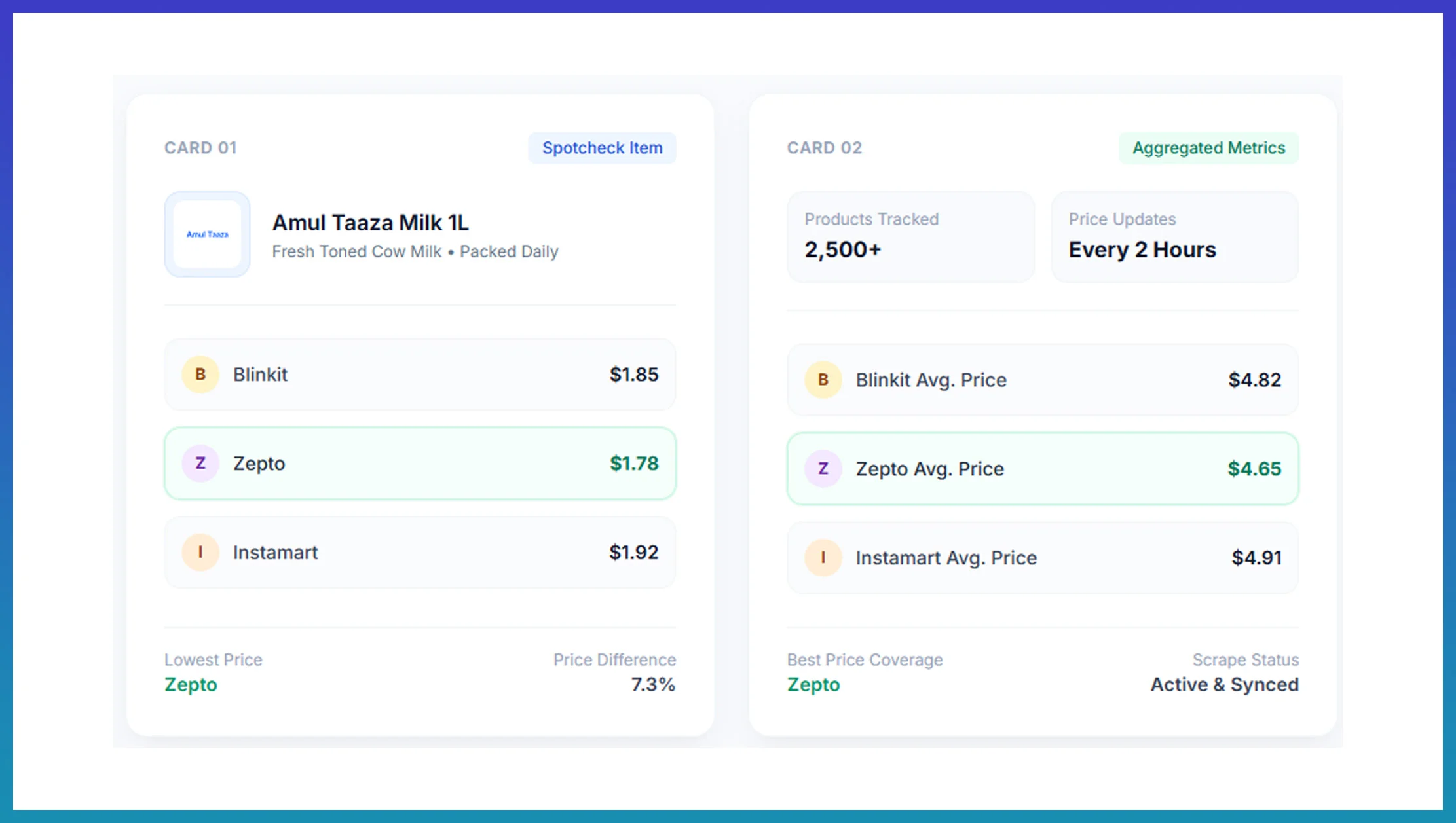
Price intelligence becomes more useful when product information from different marketplaces follows consistent fields and naming structures. Extract Grocery Pricing Dataset Blinkit Zepto Instamart can help organize product titles, variants, prices, discounts, categories, and availability into comparable records. Standardized datasets allow analysts to examine equivalent products without repeatedly navigating individual marketplace listings.
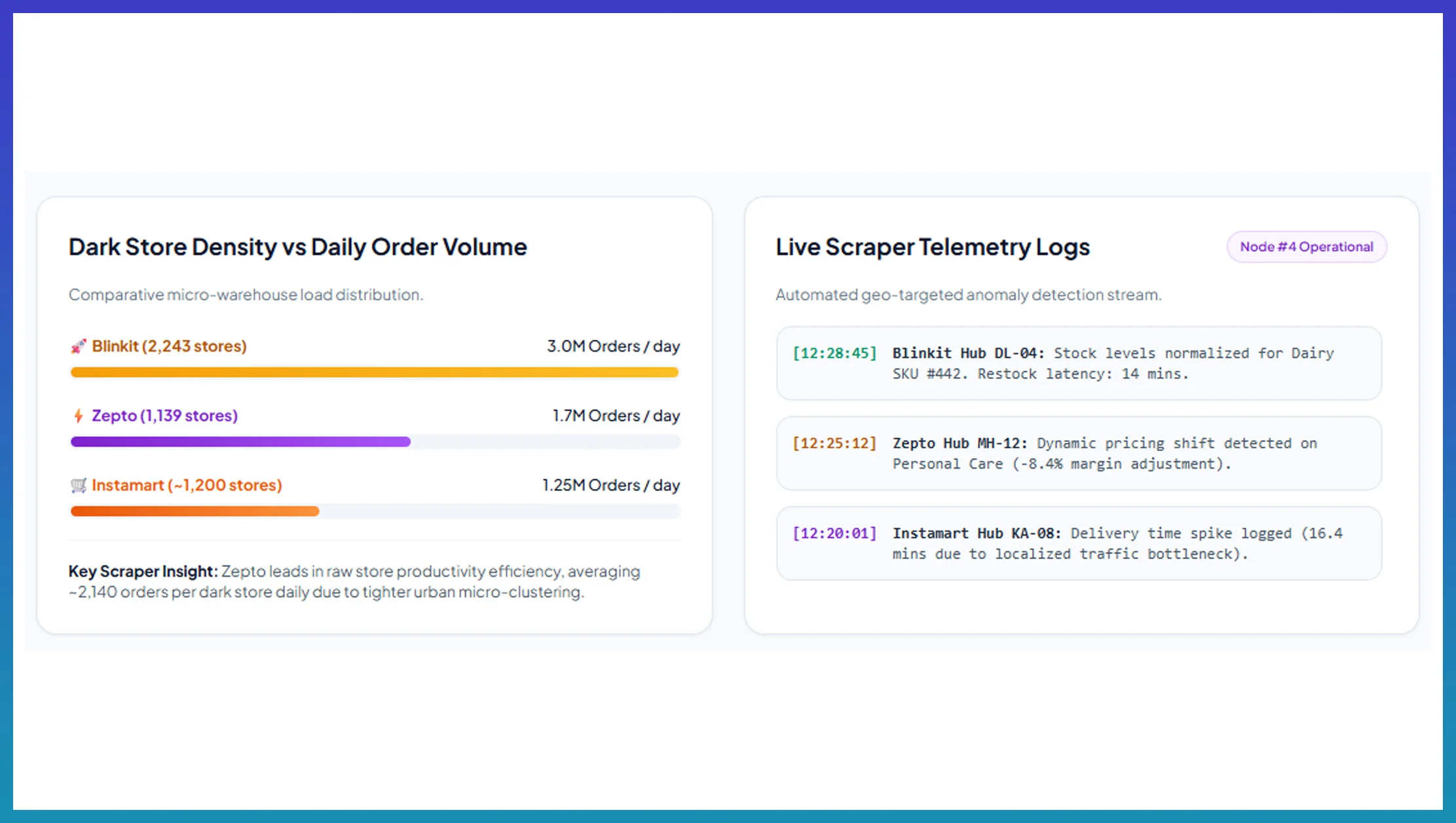
For Zepto-focused analysis, Zepto Datasets can provide organized information around grocery products, package sizes, selling prices, promotional labels, availability, and location-specific observations. Capturing these attributes at recurring intervals creates a historical record that can be reviewed alongside information from other quick commerce platforms. This approach supports product matching and makes pricing differences easier to identify.
| Data Attribute | Analytical Purpose |
|---|---|
| Product category | Category comparison |
| Product variant | SKU matching |
| Current price | Price tracking |
| Discount value | Promotion analysis |
| Stock status | Availability review |
Consistent collection can help FMCG teams identify recurring promotional patterns and pricing variations. For example, a product may carry different promotional values across locations or show changing availability during high-demand periods. Historical datasets make such differences easier to document and review over time.
Key monitoring activities can include:
- Standardizing product information across platforms
- Matching similar grocery variants
- Recording recurring price changes
- Monitoring promotional activity
- Tracking location-specific availability
A well-organized pricing dataset also reduces repetitive research efforts. Analysts can use structured records for recurring category reviews, competitive assessments, promotional planning, and internal reporting. When product-level observations are maintained consistently, teams can compare marketplace activity more efficiently and identify meaningful shifts in quick commerce pricing behavior.
Distinct Instamart Offer Trends Shaping FMCG Competitive Pricing
Promotional activity can significantly influence how FMCG products are positioned across quick commerce platforms. Blinkit vs Zepto vs Instamart Pricing Analysis for Fmcg Brands provides a structured approach for examining differences in product pricing, promotional intensity, assortment, and availability. Such comparisons become more useful when the same product attributes are collected consistently across each marketplace.
Offer-level monitoring can be strengthened through a Blinkit Zepto and Instamart Grocery Offer & Discount Data Scraper, which can organize promotional information into structured records. Data collection may include offer labels, discount values, product names, pack sizes, selling prices, and availability. Repeated observations can help analysts understand how promotional conditions change across products and locations.
| Monitoring Area | Practical Application |
|---|---|
| Offer type | Campaign classification |
| Discount value | Promotion measurement |
| Product assortment | Range comparison |
| Availability | Stock assessment |
| Location | Regional analysis |
Historical records can help teams review whether promotional changes are temporary or recurring. FMCG analysts may also compare different product variants to understand how package size, category, and promotional positioning influence marketplace visibility. Instamart Datasets can capture availability, promotional labels, pack information, and location variations.
Important collection activities include:
- Recording promotional offer details
- Monitoring discount changes
- Comparing product assortment
- Tracking availability by market
- Maintaining historical marketplace records
Structured information can also support reporting teams that need recurring competitive reviews. Rather than relying on occasional manual observations, analysts can work with consistent records that make pricing and promotion movements easier to compare. This helps create a clearer picture of marketplace activity and supports data-driven FMCG research across quick commerce channels.
How Web Fusion Data Can Help You?
For FMCG teams, Scrape Real-Time Price Intelligence for Quick Commerce can become a structured monitoring workflow rather than a one-time collection exercise. We can organize product, pricing, promotional, availability, and location information into consistent datasets for recurring marketplace analysis. The collected information can be structured according to specific business requirements, categories, products, and locations.
Key capabilities include:
- Scheduled collection across selected quick commerce platforms
- Standardized product and category information
- Recurring price and discount monitoring
- Location-level availability tracking
- Historical records for competitive comparisons
- Structured datasets for dashboards and reports
These capabilities can reduce repetitive manual checks while giving analysts organized information for recurring reviews. Teams can maintain historical records and examine pricing movements across products, categories, and markets without depending entirely on manually collected observations.
We can further support FMCG research by organizing marketplace information into usable outputs. Blinkit Zepto and Instamart Grocery Offer & Discount Data Scraper can help structure offer details, discount values, product information, and availability signals for recurring analysis.
Conclusion
Quick commerce pricing changes frequently across products, locations, promotional campaigns, and availability conditions. By Scrape Real-Time Price Intelligence for Quick Commerce, businesses can support recurring pricing reviews, promotion monitoring, assortment assessment, and category-level research with more organized marketplace information.
Consistent monitoring also provides a practical foundation for understanding competitive marketplace activity over time. Blinkit vs Zepto vs Instamart Pricing Analysis for Fmcg Brands can help organize cross-platform observations into useful comparisons for FMCG research and reporting. Contact Web Fusion Data today to discuss your quick commerce data requirements and build a structured FMCG pricing intelligence workflow.